

This review was originally published in May 2019 by Vibha Thakare and expanded in June 2026 by Absar Ahmad to include a detailed story summary, plot analysis, thematic insights, and an ending explained section.
Superb! A bold movie which grips the audience with a remarkable cast, brilliant script, and direction. I must say after watching so many Marathi movies looks like the golden days are back for the Marathi film industry. If you are among those who are looking for real cinema, then this one is definitely for you.
Kaccha Limbu Storyline
Saying this, Kaccha Limbu is based on Jaywant Dalvi’s novel Runanubandh. The film has been adapted for the silver screen by Chinmay Mandlekar, one of my favorite writers. The movie straight away takes us into the life of Mohan Katdare. Mr. Katdare and his wife Shaila are a simple middle-class couple trying their best to take care of their son Bacchu, a mentally challenged teenager.
The couple’s life is in a constant state of struggle as they barely manage household responsibilities while simultaneously caring for a child with special needs. Their entire routine revolves around Bacchu. As he reaches adolescence, the challenges become even more complicated because he starts dealing with physical and emotional changes that neither he nor his parents fully understand.
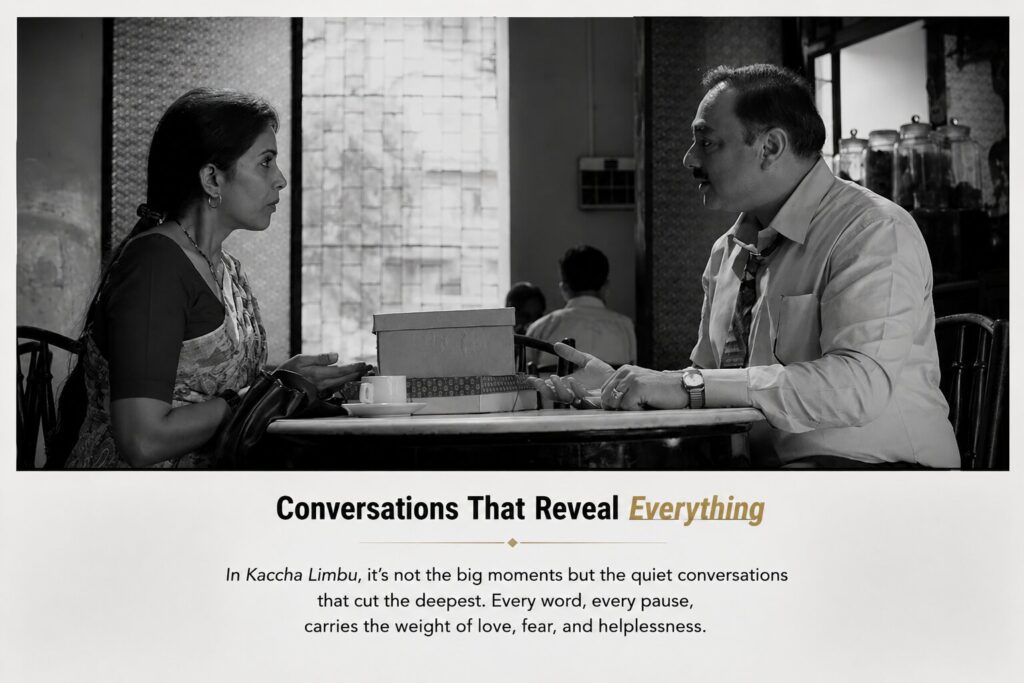
Mr. Katdare usually works the night shift while Shaila works during the day. Their lives have become so mechanical that they have almost forgotten what happiness feels like. Amid the mundanities of everyday life, they lose the meaning and color of their existence. This emotional exhaustion is beautifully reflected through the film’s black-and-white cinematography, which becomes more than just a visual choice. It becomes a representation of their state of mind.
Kaccha Limbu Story Summary
What makes the Kaccha Limbu story stand out is that it does not try to create artificial drama. Instead, it focuses on the emotional reality of a family living under extraordinary circumstances. Mohan and Shaila are not superheroes. They are ordinary parents trying to survive each day while carrying responsibilities that most people can hardly imagine.
As Bacchu grows older, the family begins facing challenges that extend beyond caregiving. Every small decision suddenly carries greater consequences. The parents are forced to think not only about the present but also about Bacchu’s future, a future filled with uncertainty.
The film does not ask the audience to pity the family. Instead, it asks us to understand them. Through everyday conversations, small frustrations, and moments of unexpected tenderness, the movie creates a deeply human portrait of parenthood, sacrifice, and resilience. The Kaccha Limbu movie story succeeds because it never feels manufactured. Everything feels authentic and painfully real.
There are two more characters worth mentioning in the movie. Shrikant Pandit, played by Sachin Khedekar, is Shaila’s boss and perhaps one of the most compassionate characters in the film. He constantly encourages the couple to find some happiness in their lives. Then there is Venkat, played by Mahadevan, who serves as Mr. Katdare’s closest friend and the one person with whom he can openly share his feelings.
While routine life continues, things take an ugly turn when Bacchu’s adolescent hormones begin kicking in and he gropes his own mother one night. Unfortunately, the incident happens again. At this point, the couple finds themselves emotionally exhausted and conflicted. Their frustration, guilt, and helplessness begin affecting the way they view their own son.
Shaila starts finding emotional comfort in her boss while Mr. Katdare immerses himself in creating what he calls the “Bacchu Fund.” His goal is to ensure financial security for Bacchu after his parents are gone and possibly provide support for other families dealing with similar situations.
Kaccha Limbu Plot Explained
The Kaccha Limbu plot revolves around a question that silently haunts every parent of a special-needs child. What happens when they are no longer around?
While the story appears simple on the surface, it is actually layered with emotional conflicts. Mohan’s biggest fear is not Bacchu’s present condition. His biggest fear is Bacchu’s future. Every sacrifice he makes is driven by a desperate need to ensure that his son remains protected even after his own death.
Shaila’s journey is equally compelling. Unlike Mohan, who focuses on practical solutions, she struggles with emotional isolation. Her connection with Shrikant Pandit reflects her need for understanding and companionship rather than romance. The film intelligently avoids turning this relationship into melodrama and instead uses it to highlight how caregiving can slowly consume an individual’s identity.
The Kaccha Limbu movie plot gains strength from its realism. There are no exaggerated villains, dramatic twists, or forced emotional scenes. The real conflict comes from everyday struggles, difficult decisions, and the emotional weight carried by the Katdare family. This grounded approach is what makes the film so effective.
With no songs in the film, debut director Prasad Oak ensures that the narrative remains engaging from beginning to end. The black-and-white cinematography perfectly complements the gray emotional landscape of the story. The visual style never feels gimmicky. Instead, it enhances the themes of loneliness, uncertainty, and emotional fatigue that run throughout the movie.
It is no surprise that such a bold subject emerged from Marathi cinema. Prasad Oak deserves immense credit for choosing a sensitive topic for his directorial debut and handling it with maturity, restraint, and empathy.
Kaccha Limbu Ending Explained
The ending of Kaccha Limbu is powerful precisely because it refuses to provide easy answers. This is not a film interested in fairy-tale resolutions. Instead, it focuses on acceptance, understanding, and the realities of life.
By the time the story reaches its conclusion, Mohan and Shaila begin understanding that Bacchu cannot simply be viewed as a responsibility or a burden. He is their son, and accepting every aspect of him becomes an important step in their emotional journey.
The significance of the ending also lies in the idea of the Bacchu Fund. Throughout the film, it represents Mohan’s deepest fear and greatest act of love. It is his attempt to continue protecting his son even when he is no longer alive. Few films explore parental anxiety with such honesty, and that is what makes the ending resonate long after the credits roll.
For those looking for a Kaccha Limbu ending explained breakdown, the film’s final message is simple but profound. Happiness does not come from perfect circumstances. It comes from acceptance, empathy, and learning to live with life’s imperfections. The Katdares do not magically solve all their problems, but they gain a deeper understanding of themselves, each other, and their son.
Themes Behind Kaccha Limbu
One of the film’s strongest themes is parental sacrifice. Mohan and Shaila dedicate their entire lives to Bacchu. Their dreams, ambitions, and personal happiness often take a back seat because their son’s needs always come first.
Another major theme is loneliness. Despite being surrounded by people, both parents experience a deep sense of isolation because very few individuals truly understand their situation. The film captures this emotional loneliness with remarkable sensitivity.
The movie also explores dignity and acceptance. Instead of portraying Bacchu merely as someone with a disability, it treats him as a complete human being with emotions, desires, frustrations, and individuality. This perspective is what elevates the film beyond a conventional family drama.
Finally, Kaccha Limbu asks an uncomfortable but important question about society’s support systems. What happens to special-needs children when their parents are gone? Through Mohan’s fears and the creation of the Bacchu Fund, the film encourages viewers to think about a reality that is often ignored.
Kaccha Limbu My Verdict
A perfect story with no glitches in performances, especially Manmeet Pem, who is absolutely laudable. His portrayal of a mentally challenged teenager is so convincing that you completely believe in the character from start to finish.
Sonali Kulkarni handles her complex role with tremendous maturity and emotional depth. Ravi Jadhav, despite being known primarily as a director, delivers a performance that feels natural and sincere. Sachin Khedekar, as always, brings warmth and credibility to every scene he appears in.
Kaccha Limbu is not an easy watch, nor is it meant to be. It is a deeply emotional film that forces us to confront realities that many people prefer not to think about. Yet it does so with compassion, honesty, and remarkable storytelling.
If you appreciate meaningful cinema that prioritizes character, emotion, and substance over commercial formulas, then Kaccha Limbu deserves a place on your watchlist. It is one of those rare films that stays with you long after it ends, reminding you that sometimes the bravest stories are the ones rooted in everyday life.
Kaccha Limbu is another reminder of why Marathi cinema continues to produce some of India’s most thoughtful and emotionally rich films. If you’re looking for more gems like this one, check out our list of the 12 Must-Watch Marathi Movies of All Time.
Kaccha Limbu Movie Rating: 8/10

