
Reviewed by: Absar Ahmad
Editor’s Note (June 2026): This review was originally published in September 2015 and has been completely revised and expanded with new analysis, updated information, and fresh insights after revisiting the film more than a decade later.
Some movies entertain us for two hours and then quietly disappear from memory. Others stay with us long after the credits roll.
The Age of Adaline belongs to the second category for me. When I first watched the film in Cinepolis, Seasons Mall, Pune back in 2015, I was captivated by its beautiful cinematography, memorable music, and the everlasting charm of Blake Lively. At the time, it felt like a unique romantic fantasy unlike anything else I had seen. More than a decade later, however, I find myself appreciating the movie for completely different reasons.
What once looked like a story about eternal youth now feels like a story about loneliness. What once appeared to be a romantic fantasy now feels like a meditation on time, loss, and the painful reality of watching life move forward while you remain exactly the same.
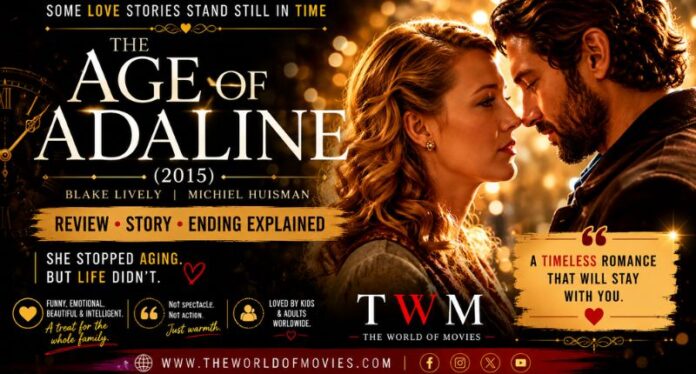
Directed by Lee Toland Krieger, The Age of Adaline tells the story of Adaline Bowman, a woman who mysteriously stops aging after a near-fatal accident in 1935. Forever trapped in the body of a twenty-nine-year-old, Adaline spends decades hiding her identity, avoiding relationships, and watching the people she loves grow old and disappear from her life.
On paper, it sounds like a fantasy. In reality, it is surprisingly heartbreaking. Believe me, it is very painful to see the world around you changing while you remain the same.
More than ten years after its release, The Age of Adaline remains one of the most emotionally resonant romantic fantasy films Hollywood has produced. While the movie does ask viewers to accept a rather far-fetched scientific explanation, the emotional truth at its core feels remarkably genuine.
At its heart, this is not a story about living forever. It is a story about the cost of living forever. And that is what makes The Age of Adaline so memorable. Since its release I have watched this movie 4 times!
Quick Verdict
The Age of Adaline at a Glance
- Genre: Romantic Fantasy Drama
- Release Year: 2015
- Director: Lee Toland Krieger
- Runtime: 113 Minutes
- My Rating: 9/10
- Best For: Fans of emotional romance movies, fantasy dramas, and character-driven stories
- Streaming: Amazon Prime Video
What Is The Age of Adaline About?
At first glance, The Age of Adaline looks like a normal romantic fantasy about a woman who discovers the secret to eternal youth. Sounds interesting, right? Well, the reality is much more complicated.
The story follows Adaline Bowman (Blake Lively), a young widow who survives a mysterious accident in 1935. Following the incident, her body stops aging completely. While the world around her continues to move forward, Adaline remains physically twenty-nine years old for decades.
Initially, this may sound like a gift to most of us. After all, who would not want to remain young forever? I certainly would love to be 29 forever!
However, the film quickly reveals the darker side of Adaline’s condition. As the years pass, she watches friends grow old, pets and loved ones die, and entire generations come and go. To protect her secret, she is forced to change identities repeatedly and avoid forming meaningful relationships. Every time she begins to build a life somewhere, she eventually has to leave it behind. The result is a lonely existence filled with constant goodbyes.
Everything changes when Adaline meets Ellis Jones (Michiel Huisman), a charming and persistent young man who makes her consider something she has avoided for decades: staying in one place and allowing herself to love again. But fate, as we all know, has other plans.
Without revealing every detail, Ellis unexpectedly connects Adaline to a chapter of her past that she believed was long gone. What follows is an emotional story about love, regret, second chances, and the burden of carrying memories that nobody else can understand.
Although the film uses a fantasy premise, its emotions feel surprisingly real. Most viewers will never experience what Adaline experiences physically, but almost everyone can relate to the fear of losing people they love or wishing they could hold on to a particular moment in time forever.

Adaline Bowman Is One of the Most Underrated Romantic Movie Characters
One reason The Age of Adaline continues to resonate years after its release is the character at its center.
Adaline Bowman is not written as a superhero blessed with immortality. Nor is she portrayed as someone who enjoys her extraordinary condition. In fact, the film constantly reminds us that her inability to age has robbed her of something deeply human: the ability to grow old alongside the people she loves. That idea alone makes Adaline a fascinating character.
Throughout the film, she carries decades of memories that nobody around her can fully understand. She has witnessed historical events such as World War, cultural changes, and technological revolutions, yet she remains emotionally trapped by the same loss that changed her life many years ago.
What makes her story particularly moving is that she never truly gets to belong anywhere. Whenever people begin asking questions, she must disappear. Whenever a relationship becomes serious, she must walk away. Whenever life starts feeling normal, she is reminded that she is different from everyone else. The greatest tragedy of Adaline’s condition is not that she cannot grow old. It is that she cannot build a future.
The film repeatedly shows that a meaningful life is not measured by how long we live but by the relationships we create and the moments we share with others. Adaline has all the time in the world, yet she spends much of it alone. That emotional contradiction gives the movie far more depth than many romantic fantasies.
Even years after watching the film, the image that stays with me is not Adaline’s beauty or her eternal youth. It is the sadness hidden behind her smile. A smile that never leaves my movie memories folder in my mind. She has lived through decades of history, but she has spent much of that time watching life pass her by. That is what makes her story so memorable.
Blake Lively Delivers a Performance That Holds the Entire Film Together
It is impossible to discuss The Age of Adaline without talking about Blake Lively. The film literally lives and dies with its central character, and Lively carries that responsibility remarkably well. Adaline Bowman is required to be many things at once. She must appear confident yet vulnerable, elegant yet lonely, emotionally distant yet deeply human. More importantly, she must convince viewers that she has lived through nearly eight decades of history while still looking twenty-nine years old.
Blake Lively succeeds because she never treats Adaline as a fantasy character. Behind every smile is a hint of sadness. Behind every new beginning is the fear of another goodbye. Even during the film’s lighter romantic moments, there is always a sense that Adaline is carrying memories and heartbreak that nobody around her can fully understand.
What impressed me most when I first watched the movie in 2015 was how naturally Blake Lively seemed to belong in every era the film portrayed. Whether she appeared in the elegant fashion of the 1920s and 1930s, the glamorous styles of the 1940s and 1950s, or the modern setting of the film itself, she never looked out of place. The various dresses, hairstyles, and costumes do more than showcase her beauty; they help us believe that Adaline has genuinely lived through generations of change. More than a decade later, that feeling remains unchanged.
There is a timeless elegance to Blake Lively’s performance that perfectly matches the character she is playing. The film asks viewers to believe that one woman has quietly existed across multiple decades of American history, and Lively makes that idea feel surprisingly believable.
When I originally reviewed The Age of Adaline in 2015, I wrote that Blake Lively had “literally lived through the ages on the silver screen.” Years later, I still feel the same way.
Her beauty may be what first captures your attention, but it is the quiet loneliness behind her performance that stays with you long after the movie ends.
The Real Theme of The Age of Adaline Is Loneliness, Not Immortality
Most people remember The Age of Adaline for its fascinating premise. A woman stops aging after a mysterious accident and remains twenty-nine years old for decades.
It is an idea that immediately sparks curiosity because it touches on something many people have imagined at least once in their lives: What if we could stay young forever?
However, the longer the film progresses, the more it becomes clear that eternal youth is not the story’s true focus. Loneliness is.
The Age of Adaline cleverly takes a fantasy that initially sounds appealing and slowly reveals its emotional cost. Adaline appears to possess something extraordinary. She never ages. She remains beautiful. She survives while entire generations come and go.
Yet every advantage comes with a painful consequence. She cannot settle down. She cannot build a permanent home. She cannot allow people to know who she truly is. Most importantly, she cannot grow old alongside the people she loves.
The film repeatedly shows Adaline saying goodbye while everyone else moves forward. Friends disappear. Relationships end. Loved ones age while she remains exactly the same. Over time, her unusual condition transforms from a miracle into a prison.
One of the movie’s most heartbreaking ideas is that Adaline possesses something many people desire: more time. Yet she is unable to fully enjoy it.
She has decades to live. But very little opportunity to truly belong. That contradiction gives The Age of Adaline a surprising emotional depth. Beneath the romance and fantasy elements lies a story about isolation, identity, and the human need for connection.
As I have grown older, this aspect of the film has become far more meaningful to me than its fantasy premise. When I first watched The Age of Adaline, I saw a beautiful romantic story. Watching it years later, I see something else. I see a woman carrying the weight of an entire lifetime while having nobody with whom she can honestly share it.
That quiet sadness is what gives the film its emotional power. And it is one of the reasons The Age of Adaline continues to stay with audiences long after the credits roll.
Harrison Ford Quietly Delivers the Film’s Most Emotional Moments
While Blake Lively rightfully receives most of the attention, The Age of Adaline would not be nearly as effective without Harrison Ford. His role is not large, but it is incredibly important. He delivers a classic Harrison Ford performance in a few minutes.
Ford plays William Jones, a man connected to a chapter of Adaline’s past that she has spent decades trying to leave behind. Without revealing too many spoilers, his presence forces Adaline to confront memories she would rather keep buried. What makes Ford’s performance so effective is its restraint.
There are no dramatic speeches or exaggerated emotional scenes. Instead, he relies on subtle expressions, pauses, and quiet moments that communicate far more than words ever could.
One particular sequence stands out as the emotional high point of the film. As old memories begin resurfacing, Ford conveys heartbreak, confusion, nostalgia, and acceptance with remarkable sincerity. It is a scene that changes the emotional tone of the entire story and reminds viewers that Adaline’s condition has affected far more lives than her own.
When I first watched the movie, I appreciated Harrison Ford’s role because of the dignity and warmth he brought to the character. Revisiting the film years later, I appreciate it even more.
His scenes add an emotional maturity that elevates The Age of Adaline beyond a conventional romantic fantasy. They remind us that time leaves its mark on everyone, even when it cannot leave its mark on Adaline.
It is a supporting performance, but it is also one of the film’s greatest strengths.

The Age of Adaline Ending Explained
Warning: Major Spoilers Ahead
The ending of The Age of Adaline is surprisingly simple, yet emotionally satisfying. For most of the film, Adaline believes she can never have a normal life. Her condition has forced her to spend decades hiding from the world, abandoning relationships, and constantly reinventing herself whenever people become suspicious of her unchanging appearance.
When Ellis enters her life, she finally begins imagining a future she had long convinced herself was impossible. However, the reappearance of William Jones, a man she once loved decades earlier, reminds her why she has spent so many years running away. Faced with the possibility of exposing her secret, Adaline decides to leave once again.
Then fate intervenes.
After another accident, Adaline experiences a medical reversal of the very condition that had preserved her youth for nearly eighty years. The film deliberately keeps the scientific explanation within the realm of fantasy, but the emotional meaning is much more important than the mechanics behind it. For the first time in decades, Adaline becomes mortal again. The significance of the final white strand of hair is not that she is growing older. It is that she is finally allowed to grow older.
What appears to be a small moment is actually the fulfillment of everything she has been denied throughout the film. Adaline no longer has to hide. She no longer has to run. She no longer has to fear building a future with someone she loves.
The white hair represents freedom.
For most people, aging is something to fear. For Adaline Bowman, it becomes a gift. That is why her smile in the final moments of the film feels so powerful.
Critical Reception and Box Office Performance
When The Age of Adaline was released in 2015, critical reactions were mixed. Some reviewers appreciated its emotional sincerity, elegant visuals, and performances, while others struggled with the film’s fantasy-driven premise and scientific explanations. Critics on Rotten Tomatoes awarded the film a 54% score, while audience ratings proved noticeably more positive. Many reviews specifically highlighted the performances of Blake Lively and Harrison Ford as the film’s greatest strengths.
Interestingly, the divide between critics and audiences has only made the film more fascinating over time.
Many viewers connected with the movie’s emotional themes far more than its scientific logic. The film asks audiences to accept an improbable premise, but for those willing to do so, it delivers a heartfelt story about love, loss, and the passage of time.
Commercially, The Age of Adaline performed respectably at the box office. Produced on an estimated budget of approximately $25 million, the film went on to earn around $65.7 million worldwide. While it was not a blockbuster, it was a successful release that found an audience and has continued attracting new viewers through streaming platforms over the years.
In many ways, The Age of Adaline has aged much like its central character. It may never have been the most celebrated film of its generation, but it continues to find admirers long after its theatrical release.
Frequently Asked Questions About The Age of Adaline
Is The Age of Adaline Based on a True Story?
No, The Age of Adaline is a fictional story. Adaline Bowman is not based on a real person, and the film’s central premise is entirely fictional. However, the emotional themes of love, loss, loneliness, and the passage of time feel very real, which is one reason the movie connects with so many viewers.
Why Did Adaline Stop Aging?
According to the film, Adaline stops aging after a near-fatal accident in 1935. The movie provides a scientific explanation involving a rare physical phenomenon that alters her body’s aging process. While the explanation requires some suspension of disbelief, it serves as the foundation for the story’s emotional journey.
Why Is The Age of Adaline So Popular?
The Age of Adaline remains popular because it combines romance, fantasy, and emotional storytelling in a way that feels timeless. Many viewers are drawn to Blake Lively’s performance, the film’s beautiful visuals, and the thought-provoking idea of living through decades without aging. Beneath its fantasy premise, the movie explores universal themes that continue to resonate with audiences years after its release.
Is The Age of Adaline Worth Watching in 2026?
Absolutely. More than a decade after its release, The Age of Adaline remains one of the most memorable romantic fantasy films Hollywood has produced.
Its premise may sound fantastical, but the emotions at its core feel remarkably human. Beneath the romance and mystery lies a thoughtful story about loneliness, identity, second chances, and the importance of embracing life while we have it.
Blake Lively delivers a performance that combines elegance, charm, and quiet heartbreak, while Harrison Ford provides some of the film’s most emotional moments. Add in beautiful cinematography, a memorable musical score, and a story that remains surprisingly moving years later, and it becomes easy to understand why the film continues to attract new audiences.
When I first watched The Age of Adaline in 2015, I was captivated by its beauty, romance, and unique concept. Watching it years later, I find myself appreciating something deeper.
I appreciate the sadness behind Adaline’s journey. I appreciate the way the film explores the cost of isolation. And I appreciate the reminder that a meaningful life is not measured by how long we live, but by the people we choose to share it with.
The World of Movies Rating: 9/10
If you enjoy romantic fantasy films that focus on emotion rather than spectacle, The Age of Adaline is absolutely worth your time. As of this writing, the film is available to stream on Amazon Prime Video in several regions, making it easier than ever to discover—or revisit—this modern romantic fantasy.

